News
31/10/2023
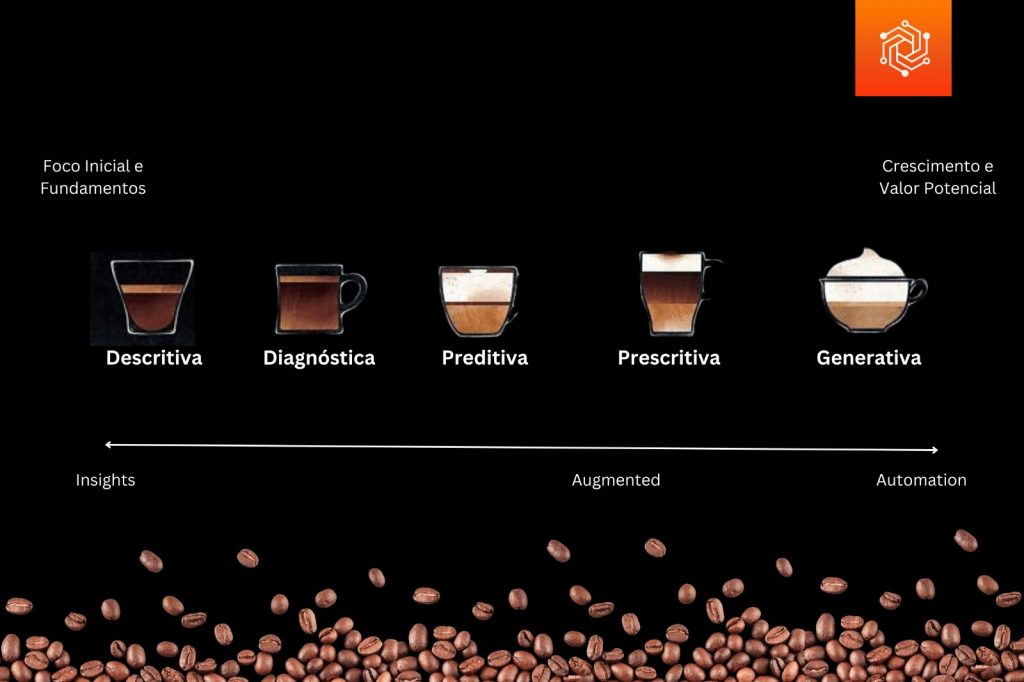
Where to Apply Analytics, Machine Learning, and Generative AI
2023 is the year of artificial intelligence; Never before has there been so much talk about this technology as is happening today. It’s an everyday topic that continues to evolve and transform rapidly, and we, as technologists, need to stay up to date if we want to contribute in some way to society. A common confusion we hear is: how is Generative AI different from other AIs? How can it be positioned so that it is easily understood by the companies that use it? Let’s explore this below.
First of all, how does a regular AI work?
A traditional AI technology has a few key characteristics. It is “task specific” and designed with explicit rules and algorithms to solve predefined problems. Additionally, it is “data-driven,” relying on structured and labeled data for training and decision making. Machine learning algorithms like decision trees, support vector machines, and logistic regressions are commonly used in this scenario.
Based on this, you can use this technology for rule-based chatbots, speech systems like Siri and Alexa, visual computing for tasks like facial recognition or X-ray analysis, document understanding where AI can read it for you and transform into another data format or provide a summary, and anomaly detection through financial transaction analysis, etc. Two main factors I could mention here: there is no “creativity function” in any of the examples above, which means that these systems do not have any technology that allows them to generate new content; they simply make decisions based on historical data patterns and rules.
How Generative AI works:
While the above two main factors of traditional AI do not apply, this is exactly where Generative AI comes in as a key differentiator. As the name suggests, Generative AI is capable of generating new content, such as images, text, music and even entire data sets, without the need for programming skills. She is more focused on generating than solving tasks. It uses deep learning models from massive public or even private data sources. There are many ways to use it; You can create an account with a Generative AI provider such as OpenAI’s ChatGPT. Additionally, you can download an entire large language model from the open source community, import it into your datacenter or cloud environment, and customize it with your sensitive data. Then you can leverage the power of Gen AI in a much more personalized and assertive use case that will help create new possibilities for you and your company.
Does this mean that Traditional AI is already “Too Traditional” and obsolete?
Of course not, traditional AI is still very relevant and will continue to be in the future. You can also combine the power of traditional AI with Generative AI to create a much more powerful solution for your scenario. Some examples could be:
Use traditional AI for content filtering and moderation on social media and use Generative AI to help you generate clean, relevant, and engaging content.
Use traditional AI for object detection or obstacle avoidance and integrate it with Generative AI to improve decision making by simulating various scenarios to help you make the best decision. Use traditional AI for rules-based fraud detection and enhance prevention with Generative AI using synthetic data to simulate more scenarios.
Using traditional AI for chatbots and combining it with Gen AI to generate content (text, images, video) based on the chatbot conversation. The future shines brightly, and the possibilities are endless, contact me and I will be happy to chat with you about this topic.
Contribution: Leandro Vieira – AI Practice Head
BROWSE BY
CATEGORY
- Analytics & AI (25)
- Digital Transformation (21)
- General (3)
- Operations (12)