News
01/08/2023
Generative AI and Text-to-Everything Automation
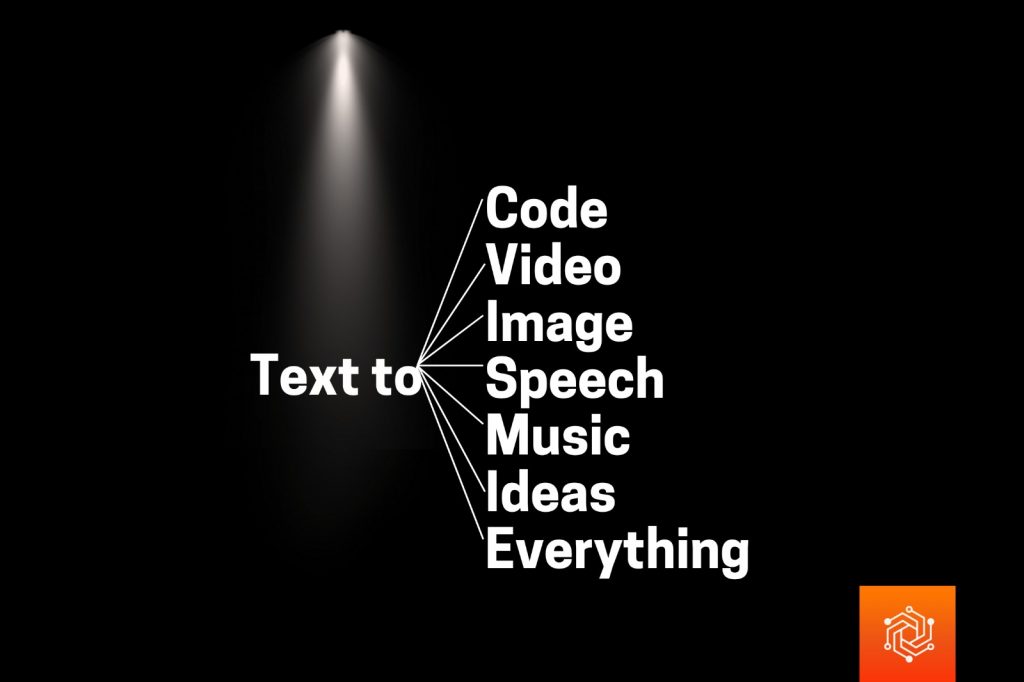
Text-to-Everything (T2X) is an innovative concept that revolutionizes the way we interact with technology. At its core, T2X harnesses the power of Natural Language Processing (NLP) and artificial intelligence to convert human language, whether in the form of written or spoken text, into multiple different outputs and actions. This innovative technology is driving significant advances in communication, automation and user experience across industries. In this article, we will explore the concept of Text-to-Everything and its wide-ranging implications.
The Rise of Text-to-Everything
Over the past decade, PLN has made significant strides in understanding and interpreting human language. With the emergence of powerful AI algorithms and the availability of vast amounts of data, machines have become increasingly proficient at processing natural language. Text-to-Everything emerged as a logical extension of NLP capabilities, enabling seamless communication between humans and machines.
Text-to-Everything Applications
Text-to-Speech (TTS): One of the best-known applications of T2X is converting written text to speech. TTS technology has improved significantly, and modern systems can generate natural, expressive speech, improving accessibility for people with visual impairments and enriching voice-based user interfaces.
Speech-to-Text (STT): Conversely, T2X can also transform spoken language into written text. STT finds applications in a variety of domains, including transcription services, voice assistants, and call center analytics.
Text-to-Translation: T2X plays a key role in breaking down language barriers by translating written text from one language to another in real time. This is especially valuable in global business operations and international communication.
Text-to-Summary: T2X-powered summarization capabilities can analyze large texts and generate concise, coherent summaries, aiding in information retrieval and understanding.
Text-to-Code: Perhaps one of the most transformative applications, T2X can automatically convert natural language descriptions into code snippets. This facilitates rapid prototyping and simplifies the development process for programmers and non-programmers alike.
Text-to-Image: T2X can interpret textual descriptions and generate corresponding images, opening up possibilities in the fields of creative design and virtual content creation.
Text-to-Emotion: Advanced T2X systems can analyze written or spoken text and accurately infer the underlying emotions of the author or speaker. This has applications in sentiment analysis for market research and customer service.
Benefits and Challenges
Text-to-Everything offers numerous benefits that drive efficiency and improve user experiences. It improves accessibility, enabling seamless interactions for people with disabilities. T2X also speeds up communication between humans and machines, simplifying complex tasks and reducing the learning curve for users. Additionally, the automation facilitated by T2X saves time and resources, fostering innovation and productivity.
However, challenges remain in improving T2X systems. Natural languages are nuanced and context-dependent, making accurate interpretation and response a complex task. Ensuring data privacy and security when dealing with sensitive textual information is also a significant concern. Continued efforts to improve algorithms and address ethical issues are necessary for widespread adoption of T2X.
Future Perspectives
The future of Text-to-Everything is bright, with potential applications in almost every industry. As AI and NLP technologies continue to advance, T2X systems will become more sophisticated and accurate, enabling even more natural interactions. From improving customer service experiences and facilitating multilingual communication to empowering developers with code generation capabilities, T2X will reshape the way we interact with technology.
In conclusion, Text-to-Everything represents a remarkable advancement in natural language processing and AI capabilities. This transformative technology has the potential to overcome communication barriers, improve accessibility, and drive automation across multiple domains. As researchers and developers continue to improve and expand the capabilities of text to everything, we can look forward to a future where interaction between humans and machines is more intuitive and productive than ever before.
Talk to our experts to find out more: https://meetings.hubspot.com/andrea-souza
BROWSE BY
CATEGORY
- Analytics & AI (25)
- Digital Transformation (21)
- General (3)
- Operations (12)