News
17/07/2023
DataOps and Other Ops Worth Your Attention
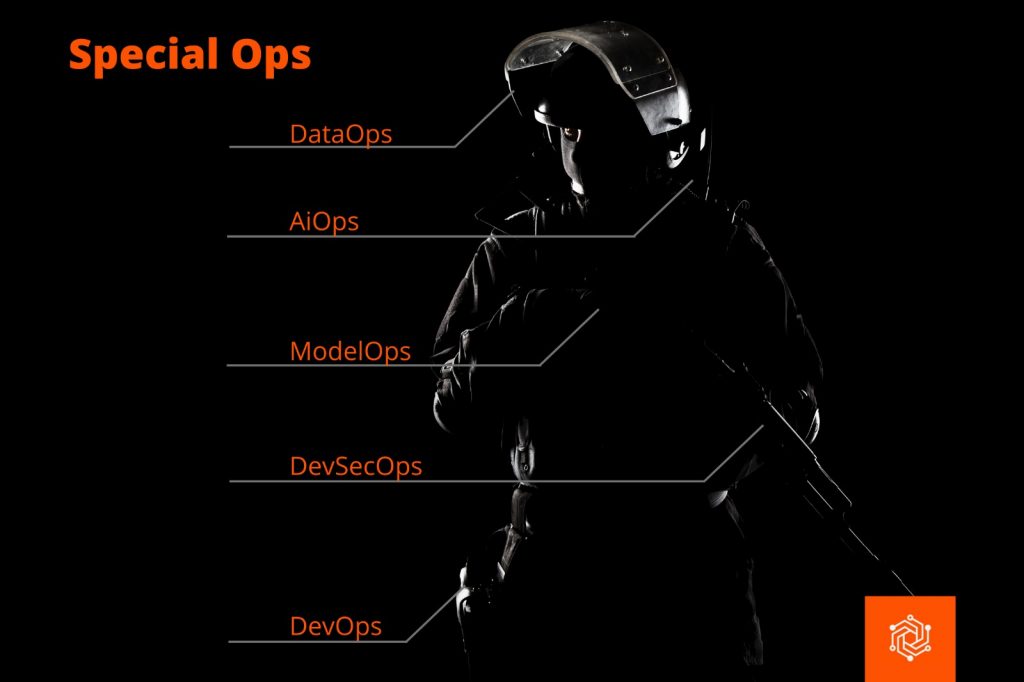
In recent years, there has been an explosion of different terms related to the world of IT operations. The operations landscape has expanded beyond the generic “IT” to include methodologies such as DevOps, DataOps, MLOps, DevSecOps and more.
Each of these areas is cross-functional across the organization and offers a unique benefit, but they all emerge from the same general mechanism: applying agile principles, originally created to guide software development, to the overlay of different types of development, related technologies (data-driven applications, artificial intelligence and machine learning) and operations.
Understand in this article how these methodologies work and find out how you can apply them in your company.
How are agile methodologies applied to IT?
The agile methodology is a simple and interactive way to transform an idea with several requirements into a software solution. It uses constant planning, understanding, updating, communication, development and delivery as part of a process that is fragmented into separate models.
Teams use agile methods to implement a project or plan by breaking it into several stages that interact with customer feedback. Development and testing are synchronized and all phases of software design or development are monitored.
Plus, because the development process is iterative, bugs are ironed out along the way, meaning you end up with a final product that’s closer to what your customer really wants.
What are the main methods applied to IT operations?
Now that you understand how agile methodologies work, let’s go one step further and explain the main frameworks applied to IT operations.
1.DevOps
DevOps is a software development method that seamlessly aligns development and IT operations in an organization to improve productivity and facilitate better collaboration between teams. DevOps is the integration of people, processes, practices, tools and technology that allows the deployment of code in a robust and automated way.
2.DataOps
DataOps is the use of agile development practices to quickly and cost-effectively create, deliver, and optimize data products. It aims to improve data management across the organization.
The term is broad and may include processes (e.g. data consumption), practices (e.g., data process automation), frameworks (e.g., enabling technologies like AI), and technologies (e.g., a data pipeline tool) to plan, build, and manage complex, distributed data architectures.
3.MLOps
MLOps is a set of practices for collaboration and communication between data scientists and operations professionals. Applying these practices increases quality, simplifies the management process, and automates the deployment of Machine Learning and Deep Learning models in large-scale production environments. It is easier to align models with business needs as well as regulatory requirements.

4.AIOps
Artificial intelligence for IT operations (AIOps) is the application of AI and related technologies such as machine learning and natural language processing (NLP) to traditional IT operations activities and tasks. With AIOps, operations teams can control the immense complexity and amount of data generated by their modern IT environments and thus avoid outages, maintain uptime and achieve continuous service assurance.
5.DevSecOps
In practice, DevSecOps is a tactical trio that connects three different disciplines: development, security and operations. The goal is to seamlessly integrate security into your continuous integration and continuous delivery (CI/CD) pipeline across pre-production (dev) and production (ops) environments.
In today’s economy, a company’s ability to compete requires processing information and making decisions faster than ever before. Optimizing data and implementing strategies from it can mean the difference between growth and extinction. In this context, DataOps, MLOps and AIOps, together with DevOps and DevSecOps, provide organizations with the ideal framework to maximize using data with analytics.
Market pressures require companies to keep up to date with technology and we help you with that! Talk to our experts The time for your digital transformation is now!
BROWSE BY
CATEGORY
- Analytics & AI (25)
- Digital Transformation (21)
- General (3)
- Operations (12)